
How much does it cost to paint the interior of a house in Melbourne?
Tricoat Painting · 3 July 2026 · 7 min read
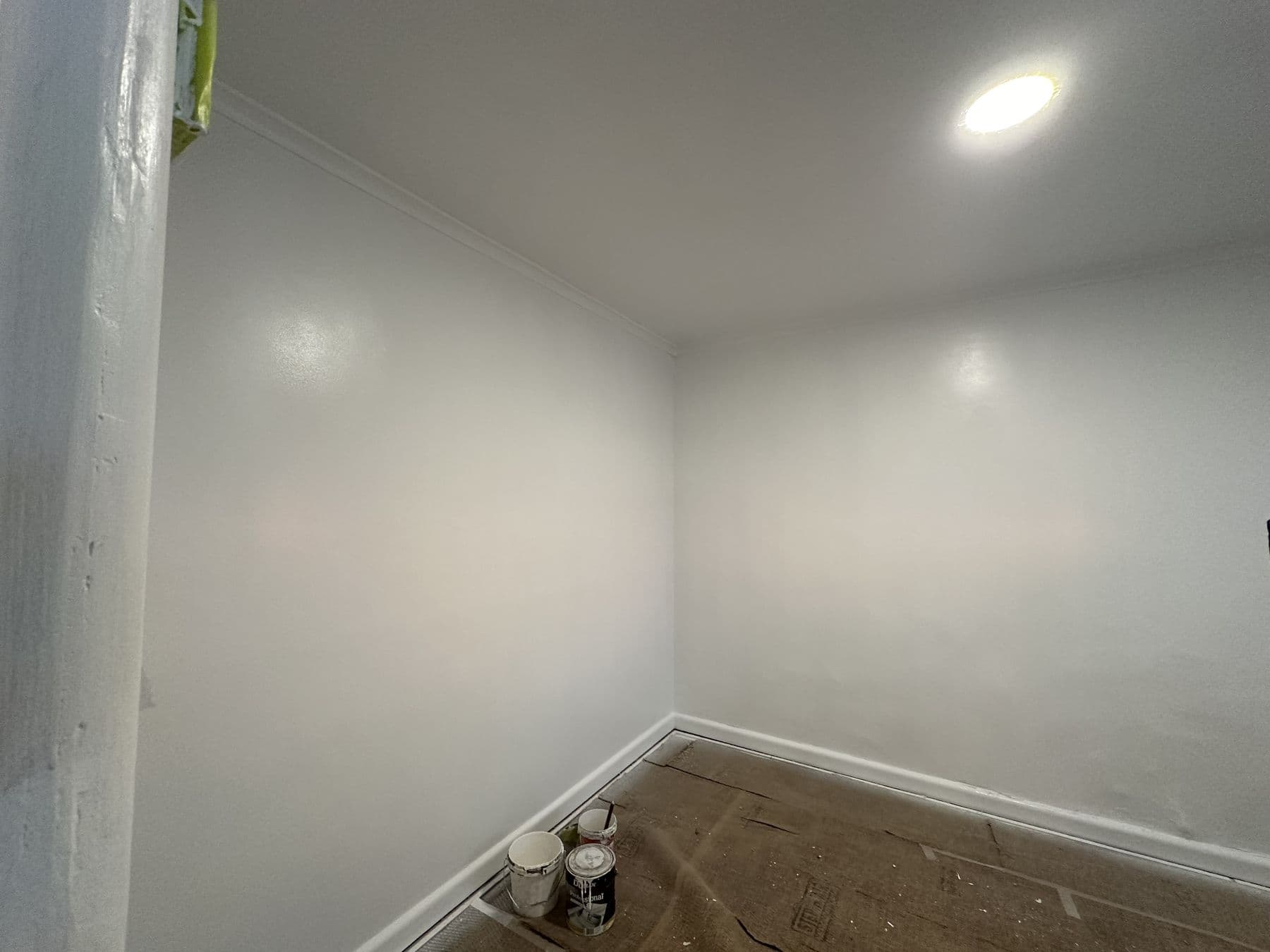
A full interior repaint of a 3-bedroom Melbourne house typically runs about $6,000–$10,000, or roughly $20–$45 per square metre of wall. Room count, ceiling height, trim and the number of colours move the figure more than the paint does; a standard bedroom often falls around $300–$750. The accurate number comes from an on-site measure.
Tricoat Painting · Updated July 2026
A full interior repaint of a 3-bedroom house in Melbourne — walls, ceilings and trim — typically runs around $6,000 to $10,000 in published 2026 price guides, with a single room landing roughly $400 to $1,500 depending on its size and whether ceilings and trim are included. Per square metre, walls-only work sits at about $20–$35/m², rising to roughly $28–$45/m² once you add ceilings and trim. The figure swings on a handful of things — surface condition, how many ceilings and how much trim, the number of colours, and how much prep the walls need before a drop of topcoat goes on. The only accurate number is a fixed quote after an on-site measure.
Those ranges come from public 2026 Melbourne painting price guides, not from us — every one is cited at the foot of this page. They're a fair sanity-check for budgeting, but no honest painter can price an interior repaint over the phone, because two houses with the same floor plan can quote a long way apart. Here's what sits behind the numbers, and how to read a quote properly.
The quick answer: indicative Melbourne ranges
| What you're pricing | Indicative range | Source |
|---|---|---|
| Interior walls only, per square metre (2 coats) | $20–$35 / m² | Golden Deco, 2026 |
| Full service — walls, ceilings and trim, per square metre | $28–$45 / m² | Golden Deco, 2026 |
| One room (size and scope dependent) | $400–$1,500 | Newline / Modernize, 2026 |
| Standard bedroom (~15 m²), full repaint | $650–$950 | Modernize / Paintpal, 2026 |
| Living room (~20–30 m²), full repaint | $1,000–$1,500 | Modernize / Paintpal, 2026 |
| Whole-home interior, 1-bed apartment / unit | $2,500–$6,000 | Golden Deco / World Class, 2026 |
| Whole-home interior, 3-bedroom house | $6,000–$10,000 | World Class / Golden Deco, 2026 |
| Whole-home interior, 4-bedroom house | $8,000–$15,000 | World Class Painting, 2026 |
Indicative published ranges for budgeting — not a Tricoat quote.
Notice how the figures stack up as scope grows. Painting the walls of a bedroom is one number; adding the ceiling, the door and the skirting is a different one — and that step-up isn't padding, it's hours. Treat any single rate as a starting point, and read the scope it's attached to.
Why prep — not paint — drives the price
Inside a house, the paint is the cheap part. Published Melbourne guides put labour and preparation at roughly 60–90% of the total on an interior repaint — the filling, sanding, masking, priming and protecting all happen before the first proper coat. That's why the price tracks the condition of your walls and the scope of the job far more than it tracks the paint tier you pick.
A proper interior prep means filling cracks and nail holes, sanding them flush, spot-priming patches and any stains, masking off trim and floors, and protecting your furniture before anyone opens a tin. Skip those hours and you'll see every flaw telegraph through the new coat in raking light. Older Melbourne homes — Victorian and Edwardian places with settled plaster, hairline cracking and decades of past coatings — need the most prep, which is exactly why a tired period interior costs more than a five-year-old townhouse of the same size. This is the heart of how we approach every interior painting job.
What actually changes the number on your quote
Two houses with the same number of bedrooms can quote thousands apart. These are the levers:
- Surface condition. Sound, smooth walls are quick. Cracks, water damage, peeling old coatings, settled plaster, mould or wallpaper to strip all add prep hours before any paint goes on — the single biggest variable, and the reason older homes cost more.
- Scope per room. Walls-only is the cheapest case. Adding ceilings, then doors, windows and skirting, each steps the price up — a room with a door, large windows and a run of skirting carries real extra hand-work over the base wall cost.
- Ceilings. Most guides fold ceilings into the room or full-service rate rather than pricing them separately, because they're labour, not paint — overhead cutting-in, extra coats on patchy or stained plaster, and trestles or scaffold for anything much above head height.
- Number of colours and dramatic changes. A single off-white through the house is fast. Going dark-to-light (or vice versa) usually needs a tinted undercoat plus two topcoats — effectively three coats — and lots of different colours mean far more cutting-in and masking time.
- Trim and detail. Doors, architraves and skirting are slow, exacting work. Internal doors are commonly quoted around $80–$200 each (both sides, jamb and architrave), and skirting runs roughly $20–$40 per linear metre — figures that add up fast in a home with a lot of trim.
- Ceiling height and access. High ceilings, stairwells and voids need trestles or scaffold and more time at height. Ornate cornices and ceiling roses are labour-intensive to cut in cleanly.
- Occupied vs empty. An occupied home adds time for moving and protecting furniture, dust control and working room-by-room around you.
Why one room costs more per square metre than the whole house
Every job carries fixed set-up costs that don't shrink with the size of the work — masking up, laying drop sheets, travel, and the clean-up at the end. On a single room, those costs land on one room. On a whole-home repaint, they're spread across the lot, which is why booking the whole interior tends to be 15–25% better value per room than picking off rooms one at a time.
It's also why a tradesperson's charge-out rate looks high at first glance. Published Melbourne guides put an insured, professional painter at roughly $65–$95 per hour plus GST — well above the bare hourly wage once insurance, vehicles, materials and overheads are carried. That rate is the reason a real quote costs what it does, and it's also why a suspiciously cheap quote usually has the prep — or the insurance — quietly left out.
Can you paint inside in winter? A Melbourne note
Yes — interior work isn't bound to the warmer months the way exterior work is. Because you control the temperature and ventilation indoors, a house interior can be repainted year-round in Melbourne, winter included. Dulux's own guidance for its interior water-based paints is to apply above 10°C, keep relative humidity below about 85%, and stay clear of painting within roughly 3°C of the dew point — all conditions you can manage inside far more easily than out in the weather.
The naturally stable windows — late spring and early autumn — are the most comfortable for it, but the only real winter caveat is condensation: indoor heating against cold walls can leave surfaces damp, so they need to be fully dry and the space well ventilated before and during painting. Most interior coats are dry to touch within an hour or two and ready to recoat after a few hours, longer when it's cool or humid, so a typical room takes about a day or two including drying, and a 3-bedroom interior runs roughly 5–8 business days.
How to read an interior painting quote
When you compare quotes, the price is only half the story. Look for:
- An itemised, fixed scope. It should spell out which rooms, and whether walls, ceilings and trim are all included — not just "paint interior." Vague quotes are where surprise variations hide.
- The prep named. Filling, sanding, stain-blocking and the number of coats should be written down, so you can compare like with like rather than guessing what was assumed.
- The paint and finish. A reputable quote names the product and the finish per surface (washable walls, moisture-resistant in wet areas, gloss or satin on trim), so two quotes are actually comparable.
- GST and inclusions. Confirm the figure is GST-inclusive and covers furniture protection and clean-up, not just the painting itself.
That's how we quote every interior repaint: a fixed, itemised, GST-inclusive price after we've actually looked at the walls — never a phone ballpark, and never a surprise variation once we've started.
So, what will your interior cost?
If your walls are sound and you're after a fresh coat in a similar colour, budget toward the lower end of the published ranges above. If you've got cracking or water damage to make good, a lot of ceilings and trim, a dramatic colour change, or a period home with ornate detail and settled plaster, expect to sit higher — the prep and the hand-work are doing the work. The honest answer is that no one can give you the real figure without seeing the rooms.
We've been painting Melbourne's homes since 2008 — straightforward family repaints around our Thomastown base, and period interiors in pockets like Eaglemont that need a careful hand. For the whole-house picture including exteriors, start with our Melbourne house painting cost guide. If you'd like a fixed, itemised price for yours, book a free on-site measure and we'll quote it properly.
Want the real figure for your place?
Published ranges only get you so far. We give a fixed, itemised price after a free on-site measure — no phone ballparks, no surprise variations.
Related services
Sources
Figures are third-party published ranges for budgeting guidance, current when this guide was researched — not a Tricoat quote.
- Golden Deco — Interior Painting Cost Per Square Metre Melbourne: 2026 Guide
- Golden Deco — Residential Painting Melbourne Cost: 2026 Price Guide
- Modernize Solutions — Cost to Paint a Room Melbourne: 2026 Price Guide
- Modernize Solutions — House Painting Cost Melbourne 2026
- World Class Painting — House Interior Painting Melbourne Cost: Pricing Guide
- Newline Painting — How Much Does Interior Painting Cost? Melbourne 2026 Prices
- Paintpal — Interior Painting Cost Per Room Melbourne 2026 Guide
- Localsearch — Cost to Paint Interior of House (guide)
- The Painting Company — How Much Do Painters Charge Per Hour in Melbourne
- PayScale — Painter Hourly Pay in Melbourne, Victoria
- Dulux — Wash & Wear Matt technical data sheet (application temperature/humidity/dew point/cure)
Frequently asked questions
How much does it cost to paint the interior of a house in Melbourne?
How much does it cost to paint one room?
What's the cost per square metre to paint interior walls in Melbourne?
Why does interior painting cost what it does — isn't it just paint?
Does changing colour — say dark to light — cost more?
Why can't you give me a price over the phone?
Ready for a paint job that lasts?
Free measure across Melbourne's north and east. Honest scope, fair price, no mess left behind.